8 Airports Known to Challenge Private Jets — And How to Prepare for Them with Smart OPS Strategy
Private jets epitomize efficiency — yet some airports around the globe demand far more from flight crews and operations teams than others. Short runways, steep approaches, high-elevation terrain, congested slot systems, and complex weather patterns turn routine missions into high-skill operations.
Planning and anticipating these constraints is what separates a smooth operation from a mission at risk.
Below, we break down 8 airports globally recognized as difficult for private jets, including ICAO data, technical considerations, and preparation strategy.Among them — Nice Côte d’Azur Airport (LFMN): AirWise’s exclusive base of operation, where on-site expertise and licensed airside access make a critical difference.

1) Gibraltar International Airport (GIB / LXGB)
Why it’s difficult
RWY 09/27: 1,777 m
Until 2023, the active runway intersected Winston Churchill Avenue
Frequent levanter crosswinds affecting RWY alignment
Highly restricted ground space and GSE availability
Preparation Strategy
Request parking & stand allocation well in advance
Closely evaluate crosswind limits vs. aircraft weight
Ground services must be pre-positioned — no improvisation
2) London Heathrow (LHR / EGLL)
Why it’s difficult
One of the most congested airports worldwide
Slots controlled by ACL — extremely restrictive for BA
Parking is scarce and not prioritised for private jets
How to Prepare
Submit ACL slot requests as early as release periods open
Maintain wide ETA/ETD margins for taxi waiting
Keep business-aviation alternates planned:Farnborough EGLF / FAB, Biggin Hill EGKB / BQH, Stansted EGSS / STN
3) London City (LCY / EGLC) — Europe’s steepest approach runway
Technical Constraints
5.5° approach angle, only steep-certified aircraft accepted
Runway length 1,508 m
No tolerance for delay, traffic density high
Preparation Notes
Verify aircraft Steep Approach Approval (PC-24, E190-ST, select Falcons)
Turnaround planning must be exact to the minute
Expect slot refusal if your timing drifts
4) Courchevel Altiport (LFLJ) — The legendary alpine challenge
Airport Realities
Runway 537 m with 18.5% gradient
VFR-only, no IFR procedures
Pilot mountain qualification mandatory
How to Prepare
Analyse takeoff & landing performance precisely
Monitor visibility and winds hour-by-hour
Winter congestion means heli/ground transfer planning is essential
5) Samedan / St. Moritz (LSZS)
Characteristics
Elevation: 5,600 ft — density altitude impacts performance
VFR-dependent — visibility is everything
Surrounded by mountains → turbulence & valley winds
How to Prepare
Factor performance penalties at high DA
Pre-arrange fuel & parking well before winter season peaks
Expect wind shear & variable descent conditions

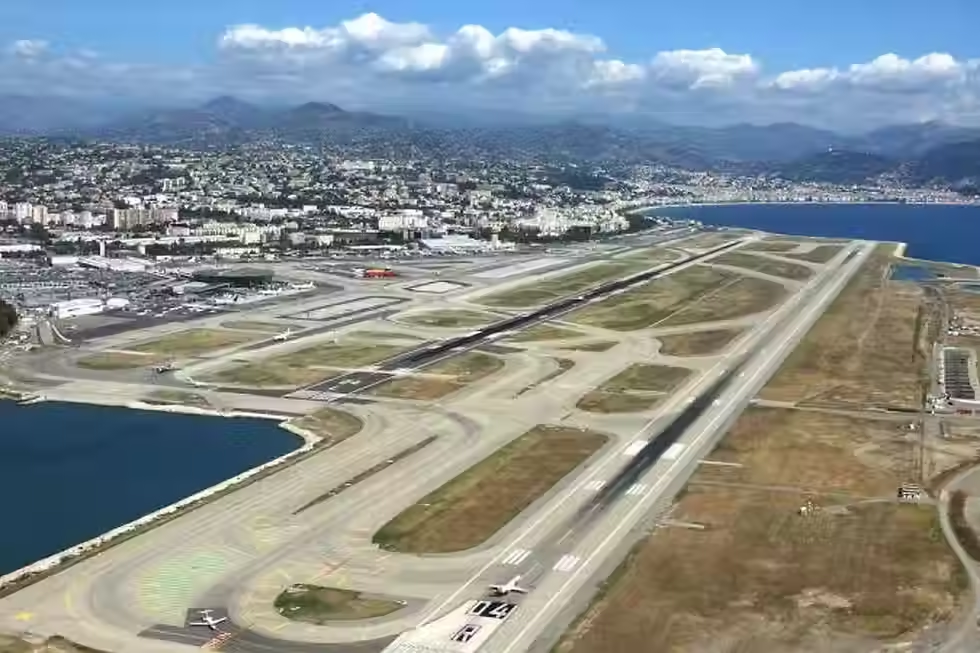
6) Nice Côte d’Azur Airport (LFMN / NCE)
The French Riviera’s busiest private jet hub — demanding, saturated, weather-sensitive
Among European airports, Nice Côte d’Azur stands out for operational complexity, especially during peak seasons and flagship events.
Why Nice is classified as a difficult airport
ICAO: LFMN | IATA: NCE
#3 busiest business aviation airport in Europe
Crosswinds & wind-shear risk due to coastal geography
Parking stands regularly reach capacity during:
Monaco Grand Prix
Cannes Film Festival
Monaco Yacht Show
UNOC3 Nice 2025
Summer weekends & holiday waves
Where AirWise Makes the Difference at LFMN
(Only in Nice — 100% local. 100% airside-accredited.)
AirWise Executive Flight Support is the only part of this article that represents a real-time on-site partner — and exclusively at NICE.We are physically present inside LFMN with full ramp-security clearance, enabling us to operate beside the aircraft, not remotely.
AirWise services at NICE include:
✔ Slot & parking management with CDM/DSNA
✔ Live weather & wind-shear flight watch
✔ VIP crew & passenger meet-and-assist airside
✔ Full ramp supervision (fuel, GPU, stairs, lav, potable water)
✔ Catering coordination — including luxury restaurant pickups
✔ Real-time ATC, handler & FBO liaison to avoid delays
Without a local supervisor at LFMN, operators risk:
✘ denied stands
✘ slot loss
✘ queue & taxi restrictions
✘ catering loading delays
✘ lack of rapid recovery in case of weather or ATC change
With AirWise — every detail is controlled and protected.
7) Aspen / ASE (KASE)
Challenges
Elevation 7,820 ft → density altitude critical
Runway 2,438 m but performance heavily degraded in heat
Special FAA procedures in narrow valley terrain
Preparation
Reduce MTOW to maintain adequate climb performance
File alternates: Rifle RIL, Eagle EGE
Monitor temperature impact — summer DA is a true threat
8) Teterboro / TEB (KTEB)
Difficulties
One of the world’s busiest private jet hubs
Strict noise abatement & peak congestion
GSE availability + taxi flow often delayed
How to Prepare
Pre-book fuel, GPU, ASU, handling slots early
Maintain alternates: HPN, MMU, EWR
Ground movement delays common — avoid tight ETD planning
Why Preparation = Success in Difficult Airports
Technical airports don’t punish prepared operators — they reward them.
Proper planning, performance awareness, slot security and local coordination transform risk into predictability.
And in Nice (LFMN), this is exactly the role AirWise fulfills.
When flying to Nice Côte d’Azur LFMN — a local supervisor is not optional. It is strategic.
AirWise protects your movement from the minute you plan to the moment you depart.
Contact AirWise for slot requests, VIP ground supervision and operational support at LFMN:📩 fbo.nce@airwiseexecutive.com


Comments