Nice Airport Upgrades You Need to Know for 2026
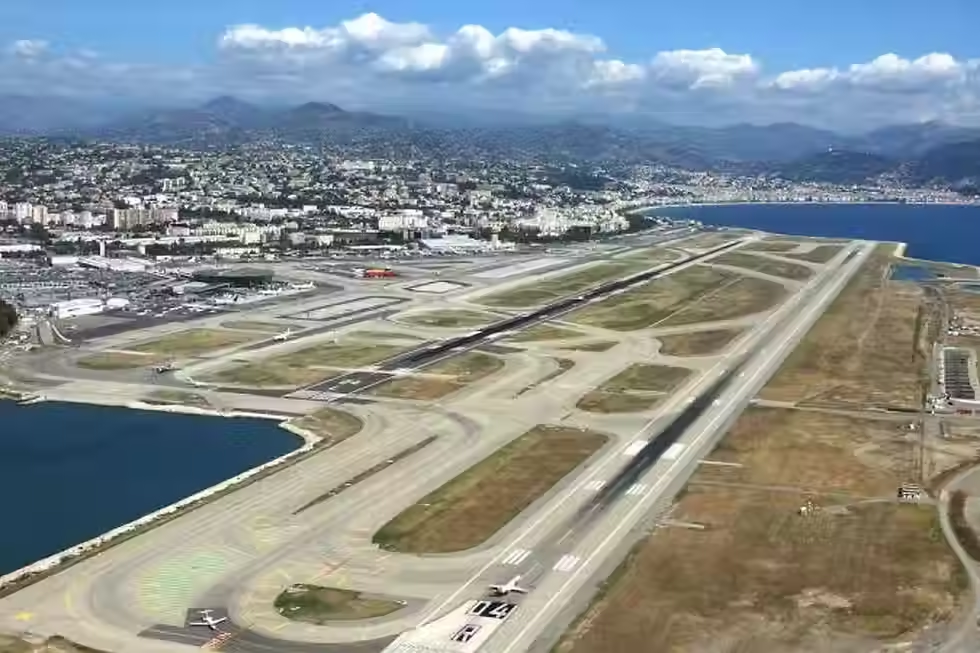
Nice Côte d’Azur Airport (LFMN), the main gateway to Monaco, Cannes, Saint-Tropez and the French Riviera’s globally recognized events calendar, is entering its most significant operational evolution in over a decade. The 2026 upgrades introduce a more structured, capacity-conscious, environmentally regulated and multimodal aviation environment that directly impacts private jet movements.
Whether flying in a long-range corporate jet, managing fleet operations, or coordinating high-profile charter movements, operators now face an airport that demands more preparation, more accuracy and stronger local coordination than in previous years.
This technical guide explains the upgrades and how they affect slot access, ground power, APU use, customs protocols, ramp logistics, turnaround efficiency and rotorcraft/eVTOL integration.
Terminal Expansion and Passenger Zone Modernization
2026 finalizes the multi-year modernization program expanding Terminal 2 by approximately 25,000 m². These changes reshape the airport’s handling capability during congested commercial and private traffic periods.
Improvements relevant to private aviation include:
Additional premium and VIP lounges suitable for holding VIP passengers during weather or slot delays
Acoustic treatment of rest areas and revised lighting to reduce fatigue
Enhanced signage and multilingual wayfinding to support international segmentation
Re-engineered baggage corridors reducing bottlenecks
New retail and concierge-style commercial offerings reflective of Riviera luxury demand
Revised terminal flow separating arrivals, departures and connecting movements
While most private passengers will continue to transit via the GAT or FBO infrastructure, mixed itineraries and schedule disruption make terminal capability more relevant than ever for operators and crews.
APU Safety, Noise Corridor Mapping and Heat-Risk Considerations for 2026
As environmental pressure intensifies, APU restrictions now sit at the center of operational decision-making in Nice. The airport’s coastal geography and proximity to residential areas amplify noise impact and emissions visibility.
Expected APU limitations include:
Immediate shutdown post-GPU connection
Limited pre-departure use only when authorized
Highly restricted idle-time on remote stands
Compliance factored into stand assignment
Possible recording of APU burn for ESG reporting
Additional operational considerations:
Jet blast mitigation may require tow-only repositioning
Climate-control timing must align precisely with GPU availability
Summer heat imposes higher cabin conditioning demands
Ramp worker heat exposure regulation affects service pacing
The APU is no longer a buffer for planning mistakes — onboard comfort now depends on ground-power precision.
GPU and 400Hz Ground Power Integration
The expansion includes broader 400Hz fixed power supply and mobile GPU access, but resource allocation is prioritized and must be requested in advance.
Key implications for dispatch and crew:
GPU determines comfort windows for VIP boarding
Last-minute GPU requests may not be possible during peak
GPU availability can affect stand category
Mobile GPUs may require tow vehicle coordination
GPU vs APU usage may be reflected on post-operation reports
A short turnaround is now a technical choreography, not an assumption.
Turnaround Time and Efficiency: 2019 vs 2026 Technical Comparison
Operational Phase | Typical Time in 2019 | Estimated Time in 2026 | Why |
GPU Connection | 6–12 min | 2–6 min | Better infrastructure, still handler-dependent |
Passenger Offload | 4–10 min | 3–8 min | Revised access gates |
Luggage Transfer | 12–20 min | 10–14 min | New baggage corridors |
Catering Acceptance | 20–45 min | 15–30 min | Structured sanitary process |
Customs Control | 10–25 min | 6–20 min | Digital screening |
Some phases improve , others require stricter timing and data accuracy.
Stand Reconfiguration, Parking Prioritization and Movement Management
Parking demand in Nice is evolving faster than apron volume. Operators should expect:
Increased remote stands for longer stays
Dynamic repositioning due to event saturation
Tow-only repositioning during specific hours
Stand type allocated based on aircraft category, ESG profile and ground-time
More shuttle dependency for crew if supervision is not present
Predictability requires proactive positioning, not reactive requests.
Customs Digitization and Passenger Flow in 2026
Digital identity screening and biometric processing impact private jet routing.
Operational impacts:
Passport details must be transmitted accurately before arrival
VIP routing depends on data validation
Diplomatic and “special profile” approvals will tighten
Misaligned manifests may result in holds or interview delays
Digitization accelerates , but only for the organized.
Predicted Impact of eVTOL and Rotorcraft Integration on Slot Competition
The rise of eVTOL services introduces a competitive dynamic beyond fixed-wing traffic.
eVTOL operations will:
Require more frequent pad turnover
Be slot-driven like helicopters
Impact stand assignments during peak
Introduce charging or staging areas affecting ramp routing
Expect greater pressure during:
Monaco GP
Cannes Film Festival
Cannes Lions
Summer weekends
Major yacht migrations
Helicopter transfers were already competitive , eVTOL accelerates that pressure.
Recommended SOP Updates for Flight Departments Operating to Nice in 2026
To maintain operational reliability, flight departments should integrate:
GPU requirement in initial slot request
APU OFF timeline into flight briefings
Accurate passenger manifest confirmation 24 hours prior
Clear internal communication chain: Operator → Dispatcher → Handler → Crew
Contingency transport plan for remote stands
Rotorcraft timing factored into stand availability
Customs digital checkpoints into passenger routing plans
SOP updates must recognize Nice as a capacity-managed, environmentally regulated, multimodal hub — not a conventional seasonal airport.
Stand Reconfiguration, Parking Prioritization and Movement Management
Nice’s apron environment continues to evolve with stand assignment based on:
Aircraft size and emissions
Turnaround duration
Ground asset requirement
Multimodal connection
Noise profile
Operational reality in 2026:
Remote stands are more frequent
Repositioning may occur with or without crew present
Tow-only windows may limit movement
Crew transport time increases without supervision
Parking predictability ends when peak season begins.
Customs Digitization and Passenger Flow in 2026
Digital identity and biometric screening shape the new arrival profile.
Operators must expect:
Mandatory passenger detail accuracy
Low tolerance for manifest deviations
Digital validation impacting escort speed
Compliance governing VIP and diplomatic routing
Customs digitization reduces time for prepared operators and delays those relying on flexibility.
Predicted Impact of eVTOL and Rotorcraft Integration
Rotorcraft and future eVTOL operations will influence:
Stand allocation
Passenger routing timing
Short-notice arrival approvals
Charging and pad staging needs
Peak-event pressure now includes two aircraft categories, not one.
Nice Arrival for Dispatchers
Nice requires dispatchers to operate proactively, not reactively. Flight planning is no longer isolated to airspace and fuel; it encompasses:
GPU/APU use
Stand type
Passenger manifest validation
Customs slot interaction
eVTOL timeline compatibility
Vehicle route clearance
At Nice, accuracy is operational currency.
The Top Myths About Operating to Nice Airport
Myth 1: VIP status bypasses procedures.Reality: Biometrics and data validation apply to all.
Myth 2: Nice is a leisure airport.Reality: Traffic saturation aligns with major capital airports.
Myth 3: APU is a comfort guarantee.Reality: APU is curtailed, timed, and monitored.
Myth 4: Passenger additions can occur in-flight.Reality: Digital systems make this a compliance breach.
Nice vs Le Bourget vs Geneva – Comparative Operational Analysis
Airport | Advantage | Core Limitation | Recommended Use |
Nice (LFMN) | Multimodal hub, Riviera access, SAF alignment | Stand scarcity, compliance sensitivity | Ultra-high-end leisure & event ops |
Le Bourget (LFPB) | Largest GA hub, multiple FBOs | Curfews, ESG oversight | Corporate European basing |
Geneva (LSGG) | Diplomatic, NGO, alpine positioning | Limited parking, weather | Winter & official missions |
Nice now shares the operational complexity of Le Bourget and the capacity constraints of Geneva — without the flexibility of either.
Fun Facts Most Operators Don’t Know About Nice Airport
Nice has one of the few international runways in Europe built partially on the sea, supported by reclaimed land and reinforced maritime structures.
Because the airport sits parallel to the shoreline, landing into Runway 04 can give the impression of descending into the water — especially for passengers new to the Riviera.
Nice handles more helicopter traffic per square kilometer than any airport in the EU during peak summer, due to Monaco commuter links.
The airport was originally conceived as a dual-purpose maritime and aviation platform, with conceptual drawings from the 1940s showing sea-plane integration.
During peak Cannes and Monaco traffic, private jets outnumber commercial flights, reversing the ratio found at nearly all other major airports in Europe.
Why Nice Is One of the Most Filmed Airports in Europe
Nice Côte d’Azur has appeared in over 30 international movies and commercials linked to the Riviera.
Aerial arrival shots of the Bay of Angels are among the most requested by European production companies.
The combination of sea-approach, coastal runway, and turquoise water makes Nice a signature aviation filming location.
Nice Airport in Numbers
18 million passenger capacity after expansion
Over 36,000 business aviation movements per year
More than 130 helicopter flights daily during event periods
Two runways parallel to the Mediterranean coastline
7–12 minute helicopter link to Monaco
Over 160 destinations served in peak schedule
Private jets account for up to 40% of movements during May events
Final Thoughts: How AirWise Supports Reliable Operations at Nice Airport
With the 2026 upgrades, Nice becomes a precision-driven operational environment. From APU limitation and GPU dependency to digitized customs and rotorcraft integration, success depends on early alignment, communication discipline, and real-time local oversight.
A licensed, airside-authorized local supervisor such as AirWise ensures:
GPU and APU timing are executed without cabin comfort loss
Passenger documentation is validated before arrival
eVTOL and helicopter transfers align with stand assignment
Remote stand relocations are supervised
Vehicle and baggage routing occur discreetly and on schedule
In 2026, reliability at Nice is not delivered by infrastructure , it is delivered by those who understand how to navigate it.


Comments