Immigration for VIP Travelers in 2026: The Complete Guide for Private Jet Operators at French Riviera Airports

The French Riviera remains one of the most exclusive destinations in the world for private jet travel. Its airports, Nice Côte d’Azur (LFMN), Cannes Mandelieu (LFMD), Toulon Hyères (LFTH), La Môle–Saint-Tropez (LFTZ), and Marseille Provence (LFML),welcome business leaders, high-net-worth families, entertainment figures, yacht owners, and corporate delegations year-round.
Yet in 2026, immigration procedures for VIP travelers are undergoing their most significant transformation in decades. The introduction of digital border systems, new biometric requirements, expanded data compliance rules, and airport-specific workflows mean private aviation operators can no longer rely.
1. How Immigration Is Changing in 2026: The New Operational Landscape
The European Union has launched major digital programs designed to modernize border control. At the same time, French Riviera airports are adapting their operational models due to:
surging private jet traffic
new security requirements
expanded customs workloads
multiple event-based traffic spikes
limited airport infrastructure
VIP treatment remains discreet and premium, but no longer exempt from compliance.Every private jet arrival must fit within a stricter digital and regulatory framework. on assumptions of speed, flexibility, or VIP exemption.
For dispatchers, brokers, flight departments, and corporate aviation teams, ensuring seamless immigration now requires anticipation, accuracy, and expert local coordination, especially during the intense seasonal peaks the Riviera is famous for.
This comprehensive 2026 guide explains everything operators need to know.
2. EES: The Entry/Exit System That Changes Everything
The Entry/Exit System (EES), deployed across all Schengen airports beginning 2025 and fully utilized in 2026, replaces traditional passport stamping for non-EU nationals.
EES requires:
biometric face capture
fingerprint scanning
digital passport authentication
an automated record of entries and exits
For private jet passengers:
There is no bypass, even for VIPs.
First-time arrivals take longer due to initial biometric registration.
Repeat travelers pass faster—but only if data is correct.
Manifest accuracy is now a legal requirement, not a preference.
At airports like Nice (LFMN), where peak-season private aviation volume is among the highest in Europe, EES adds a new layer of operational sensitivity.
3. ETIAS: The Second System Operators Must Prepare For
The European Travel Information and Authorization System (ETIAS), the EU’s version of ESTA, introduces pre-travel authorization for visitors from visa-exempt countries.
In practice:
Each traveler must apply online before departure.
Details must match their passport exactly.
Approval must be valid for the date of travel.
This affects private aviation because:
Last-minute passenger additions may not have ETIAS approval.
Incorrect or missing ETIAS can block boarding.
Dispatchers must verify ETIAS well before travel day.
Combined with EES, ETIAS fundamentally transforms the border process.
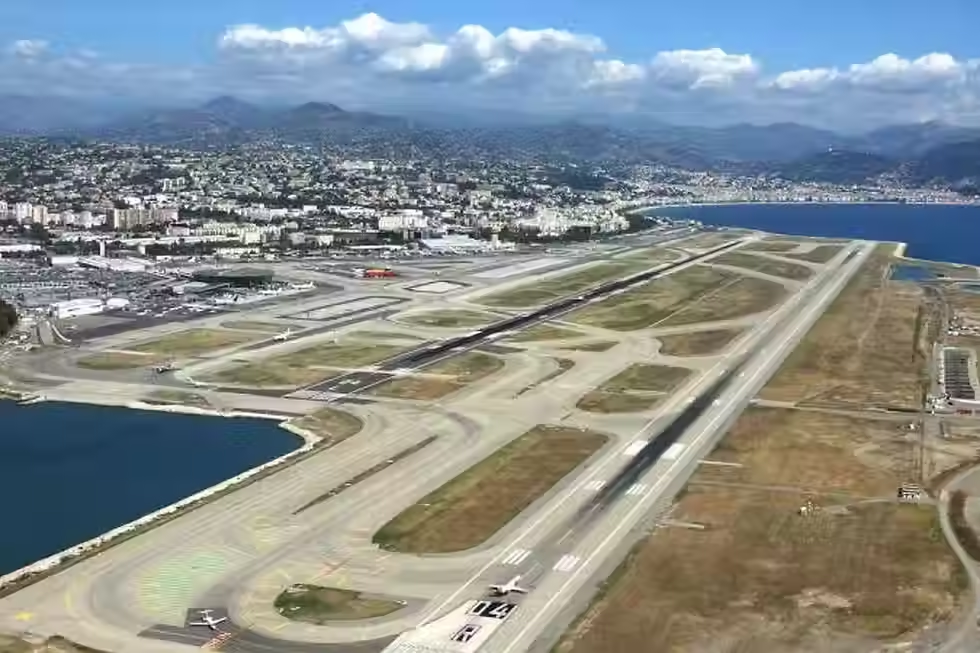
4. Nice Airport (LFMN): The Most Complex VIP Immigration Environment on the Riviera
Nice handles the largest volume of VIP movements in France after Le Bourget and is the main gateway for:
Monaco
Cannes
Saint-Tropez
Yacht charters
Corporate delegations
Major events like Cannes Film Festival, Monaco Grand Prix, MIPIM, Cannes Lions, ILTM
Nice’s immigration operations in 2026 reflect:
1. Biometric processing for all non-EU travelers
EES stations must be used for initial registration.
2. Segmented VIP routing
Depending on passenger nationality mix and customs staffing, travelers may be processed:
in the General Aviation Terminal (GAT),
in private immigration lanes,
or through controlled areas in the main terminal.
3. High customs workload
Traffic can multiply 300–350% during major events.
4. Zero tolerance for manifest errors
Any discrepancy requires manual review, delaying entry.
5. Strict timing protocols
Early or late arrivals disrupt customs resource allocation.
For operators, this is the most sensitive airport on the Riviera for immigration compliance.
5. Immigration Realities at Cannes, La Môle, and Toulon
Cannes Mandelieu (LFMD)
Immigration is available for select nationalities.
Many non-EU passengers must still clear border control at Nice first.
Event traffic saturates staff availability.
La Môle–Saint-Tropez (LFTZ)
Limited or no immigration for most non-EU visitors.
Many VIPs must clear at Nice, Marseille, or Toulon before repositioning.
Toulon Hyères (LFTH)
Increasingly used as an alternative entry point.
Immigration generally smoother than Nice during major events—but still dependent on prior coordination.
At secondary airports, the issue is not volume but capability and timing.
6. NEW: Comparing Immigration Procedures – Nice vs Marseille (2026 Analysis)
As private aviation continues to grow, Marseille Provence Airport (LFML) has become an increasingly strategic entry point for international VIP passengers.
Here is the comparison operators need.
Nice (LFMN)
Strengths:
Closest to Monaco, Cannes, Saint-Tropez
Fast dedicated lanes when supervised
Strong VIP infrastructure
Challenges:
Extremely high traffic
Biometric queues during peaks
Multi-terminal routing complexity
Customs staff saturation
Sensitive to aircraft arriving early or late
Result: The most premium but the most timing-critical and data-dependent airport.
Marseille (LFML)
Strengths:
Larger passenger capacity
Less congestion than Nice
Immigration often faster during Riviera peaks
Good for long-range arrivals
More stable customs availability
Challenges:
Longer drive times to Cannes/Monaco/St-Tropez
Limited GAT capacity compared to Nice
Requires careful ground logistics
VIP experience depends heavily on local supervision
Result: A highly effective alternative airport for international arrivals ,
especially when Nice slots or immigration flows are saturated.
7. Why Manifest Accuracy Is Now Non-Negotiable
Because EES logs identity data digitally, any mismatch creates delays.
Frequent issues include:
mismatched passport numbers
wrong nationality
misspelled names
outdated passport details
incorrect date of birth
swapped passenger order
last-minute additions
Even one error can result in:
passengers being held airside
manual inspection
secondary questioning
delayed transport
missed yacht connections
missed onward helicopter transfers
VIP experience depends entirely on perfectly prepared data.
8. Crew Immigration in 2026: New Rules, New Tracking
Crew members are also subject to:
biometric scanning (if non-EU)
digital registration of entry
Schengen stay-tracking
validation of duty schedules
separate processing lanes in some airports
Crew often process faster than passengers, but only if routing is correct. Without supervision, crew may unintentionally join commercial queues, causing unnecessary delay.
9. Most Common Causes of Immigration Delays in 2026
Operators consistently face challenges such as:
early aircraft arrivals before customs is ready
last-minute manifest changes
incomplete ETIAS authorizations
mixed nationality groups
remote stand routing
limited staffing during events
insufficient local supervision
All of these can be mitigated through preparation and ground coordination.
10. VIP Immigration Checklist for Dispatchers (2026 Edition)
A complete operational safeguard against immigration delays.
48–24 Hours Before Departure
Validate all passport information
Check ETIAS status for each eligible passenger
Verify passport dates
Submit pre-arrival passenger lists
Confirm crew nationalities and rotation
Pre-alert customs with detailed manifest
Align transport schedule with airport access windows
Day of Flight
Reconfirm ETA and send updates
Communicate changes in real time
Validate driver access
Ensure catering, fuel, and routing match timing
Recheck ETIAS status for last-minute pax
Upon Arrival
Guide passengers immediately to designated biometric points
Keep crew separated when required
Guarantee baggage is escorted directly to customs
Coordinate precise vehicle routing
Before Departure
Verify EES exit registration
Confirm passenger presence
Manage discrete airside transfer before boarding
This checklist is especially critical during high-congestion events such as the Monaco GP, Cannes Film Festival, and peak July–August traffic.
How EES & ETIAS Will Change VIP Travel by 2030
By 2030, Europe’s digital border systems , EES (Entry/Exit System) and ETIAS (European Travel Information & Authorization System) will reshape the VIP private aviation experience. What began in 2025–2026 as biometric enrollment and pre-travel authorization will evolve into a fully integrated digital identity ecosystem that influences every step of a private jet journey.
1. Digital Borders Become Fully Automated
By 2030, most Schengen airports will rely on:
Automated facial-recognition corridors
Fingerprint validation pods
Digital document readers
AI-supported risk analysis tools
Integrated traveler history databases
VIPs will move through immigration faster , but only if their digital identity data is accurate and synchronized with EU systems.
Any mismatch (passport number, expiry date, nationality, ETIAS status) will trigger:
Automatic secondary screening
Extended border checks
Possible routing away from VIP lanes
Accuracy becomes the cornerstone of seamless VIP travel.
2. Pre-Travel Compliance Happens Before Leaving Home
ETIAS will no longer be a simple authorization. By 2030, it will incorporate:
Travel intent analysis
Passport and identity cross-checks
Historical travel pattern reviews
Automated pre-arrival security scoring
This means private jet operators must ensure:
Every passenger has a valid ETIAS linked to their passport
Last-minute passengers are pre-cleared
All identity details match exactly across systems
The era of “adding a VIP guest at departure time” will be far more restricted.
3. Manifest Transmission Will Be Fully Automated
By 2030, operators will no longer manually send passenger lists to customs.Instead, systems will auto-feed data into border authorities via:
Secure API connections
Encrypted digital channels
Integrated flight-planning platforms
Authorities will receive:
Passenger identity
Crew data
Aircraft routing
Security flags
ETIAS & EES status
hours before wheels-down.
This means dispatch errors will be immediately exposed, not discovered on arrival.
4. VIP Terminals Will Become Biometric Zones
Private aviation terminals across Europe, especially at high-traffic airports like Nice and Marseille , will transition to:
Self-service biometric kiosks
Automated immigration booths
Digitally controlled airside access points
Secure, digital boarding corridors
Integrated customs screening areas
Human officers will supervise the process but will operate behind the scenes, validating digital entries rather than manually stamping passports.
VIP travelers will expect:
Zero waiting time
Instant biometric clearance
Fully private, discrete routing
This experience depends entirely on pre-arrival data accuracy.
5. Last-Minute Travel Becomes More Regulated
In 2030, operational flexibility will be shaped by digital compliance:
Adding a new passenger mid-flight may not be authorized
Incorrect data could block entry automatically
EES may require first-time travelers to undergo full biometric setup
Customs may rely on automated decision tools before permitting arrival
VIP travel remains luxurious — but less spontaneous unless all data is managed proactively.
6. Local Operational Supervision Becomes More Critical Than Ever
By 2030, VIP travel success in France will depend on the operator’s ability to manage:
Pre-arrival data flow
Biometric registration requirements
ETIAS validity checks
Secure manifest processing
Real-time coordination with customs and police
Airport-specific routing (Nice, Marseille, Toulon, Cannes)
Passenger and crew separation rules
This creates enormous pressure on dispatch teams.
Local experts such as AirWise at Nice Airport will play a key role in:
Correcting data before aircraft arrival
Preventing EES/ETIAS discrepancies
Coordinating immigration staff
Handling early or late arrivals
Managing VIP routing during peak traffic
Ensuring discretion and confidentiality
VIP service quality will depend as much on digital compliance as on physical handling.
VIP Travel in 2030 Becomes Digital-First
By 2030, Europe’s border systems will transform VIP private jet travel into a tightly synchronized digital process. Every passport, authorization, biometric scan, manifest entry, and customs check must align perfectly.
The operators who succeed will be those who:
Treat immigration as a technical operation
Integrate digital compliance into flight planning
Use local partners to manage on-the-ground precision
Prepare passengers long before departure
VIP travel will still feel effortless , but achieving that experience will require expert supervision, flawless data, and deep operational coordination.
Final Thoughts: Immigration Has Become a Precision Operation — AirWise Ensures It Feels Effortless
In 2026, immigration is no longer a simple administrative checkpoint, it is a connected system of:
biometric identity requirements
digital data compliance
airport-specific routing
resource-dependent timing
security regulations
customs workload management
VIP passengers expect seamlessness, discretion, and zero waiting — but these expectations now rely on perfect operational preparation and real-time coordination.
This is where AirWise, as a fully accredited, airside-authorized local partner, becomes essential.
AirWise ensures:
flawless pre-arrival data accuracy
customs and police preparation ahead of aircraft arrival
secure and discrete routing
ultra-fast passenger handling during biometric checks
support for early or late arrivals
expertise in Nice vs Marseille immigration dynamics
a controlled, confidential, operator-aligned experience for both passengers and crew
Immigration is now one of the most decisive moments in the passenger journey.With AirWise handling every step on the ground, operators deliver a VIP experience that remains uncompromised, even under the most demanding conditions of the 2026 aviation environment.


Comments