Dubai Airshow 2025: How Dubai Is Reshaping the Future of Global Business Aviation and Sustainable Aerospace

A Global Industry Under Transformation
For decades, North America has been the dominant force in business aviation. Around 60 percent of all large-cabin jet deliveries and flight activity still occur in the United States and Canada, powered by a mature ecosystem of corporate flight departments, fractional ownership programs, and established FBO networks. Yet, the center of gravity in business aviation is shifting.
Asia-Pacific, the Middle East, and Africa are now driving the industry’s next wave of expansion. This transformation is visible not only in aircraft sales but in the rise of new routes, infrastructure upgrades, and private investment. Governments and airport authorities across emerging regions are building dedicated business aviation terminals, new runways, and maintenance hubs to meet the growing demand from corporate and VVIP travelers.
The implications are global. Operators must navigate increasingly complex permitting systems, evolving airport infrastructure, and regional variations in fuel availability, fees, and supervision standards. In this new aviation landscape, reliability, regulatory expertise, and operational precision are more valuable than ever.
The Dubai Airshow 2025: Sustainability Meets Strategy
The Dubai Airshow 2025 captures this global transformation in a single event. Returning for its 19th edition, it stands as a symbol of innovation and sustainable progress. This year’s focus on “The Future is Here” reflects a new reality: aviation’s growth depends on its ability to balance environmental responsibility with technological advancement.
The Airshow brings together leading players such as Dubai Airports, Airbus, Boeing, Airports Council International (ACI), the General Civil Aviation Authority (GCAA), and the World Economic Forum (WEF). Their shared mission is clear — to accelerate the decarbonization of aviation through collaboration, investment, and policy alignment.
While North America remains the largest established market, Dubai’s momentum demonstrates that new centers of excellence are redefining the global hierarchy. The Middle East is no longer a secondary player; it is becoming an anchor for sustainable aerospace innovation.

oneDXB Sustainability Alliance: A Working Model for Green Airports
A centerpiece of the Airshow is the oneDXB Sustainability Alliance, spearheaded by Dubai Airports in partnership with dnata, flydubai, and several leading service providers. The initiative presents a fully sustainable aircraft turnaround process that replaces conventional practices with electric ground service equipment, renewable energy integration, and optimized slot coordination.
The Alliance exemplifies a practical, data-driven approach to sustainability — one that minimizes on-ground emissions while improving efficiency. It demonstrates that the transition to net-zero operations can be achieved through coordination, accountability, and measurable outcomes.
Sven Deckers, Director of Sustainability at Dubai Airports, summarized the urgency:“Sustainability in aviation is no longer about future ambition — it is a current necessity. The Dubai Airshow brings together global stakeholders to transform shared goals into real progress.”
Global Leadership and Technological Breakthroughs
The Airshow’s dedicated sustainability conference deepens the discussion around fuel transition, green financing, and airport decarbonization. Industry leaders are exploring how to scale Sustainable Aviation Fuel (SAF) production, deploy hydrogen propulsion, and develop hybrid-electric aircraft that can operate economically at scale.
Julien Manhes, Head of Sustainable Aviation Fuels at Airbus, emphasized that “sustainability is now a strategic priority for the entire aerospace industry.” This convergence of policy and innovation reflects a critical turning point: the sustainability conversation is no longer theoretical — it is operational.
The two-day conference features global experts such as Justin Erbacci (ACI World) and Captain Sulaiman Almuhaimedi (GCAA), focusing on the alignment between policy frameworks, financing mechanisms, and emerging technology. Dubai is using its role as a global connector to push for actionable standards that can be applied across all regions.
The Rise of Dubai South and the Mohammed Bin Rashid Aerospace Hub
Parallel to the Airshow, Dubai South continues to define itself as one of the world’s fastest-growing business aviation centers. Situated near Al Maktoum International Airport (DWC), the area is now home to the Mohammed Bin Rashid Aerospace Hub (MBRAH) — a purpose-built ecosystem for aircraft maintenance, flight training, and business jet operations.
Dubai South operates as a free-zone, offering global aerospace companies and private jet operators access to tax advantages, modern facilities, and unrestricted foreign ownership. This business-friendly environment has attracted FBOs, OEMs, and charter operators from around the world, contributing to a 15 percent increase in business aviation traffic compared to last year.
The MBRAH’s focus extends beyond infrastructure. It aims to integrate sustainability into every phase of aviation — from energy-efficient hangars to green fuel supply chains. This vision positions Dubai South as the benchmark for modern aviation hubs worldwide.
Global Shifts: North America Steady, the Rest Rising
While North America still commands the majority of the world’s private jet fleet, its growth has plateaued. Deliveries and flight activity are expected to rise only modestly over the next decade. In contrast, Asia-Pacific and the Middle East are expanding at unprecedented rates.
Forecasts suggest that 8,700 new business jets will be delivered globally over the next ten years. More than half will still go to North America, but the share for Asia-Pacific, the Middle East, and Africa is increasing every year.
In Asia-Pacific, the rebound is well underway. The regional fleet grew by more than one percent in 2024, surpassing 1,150 aircraft, with India, Australia, and Southeast Asia driving new additions. Business jet activity in Singapore, Japan, and Indonesia has already exceeded pre-2020 levels, marking a return to confidence and cross-border mobility.
The Asia-Pacific aviation market is projected to grow from USD 105 billion in 2025 to USD 160 billion by 2030, an annual growth rate of nearly nine percent. Within this expansion, business aviation will grow even faster — fueled by wealth creation, corporate demand, and the emergence of new regional operators.
Dubai’s Role as the Nexus of Global Aviation
Dubai’s strategic advantage lies in its geographical position and infrastructure readiness. It connects East and West within a six-hour flight radius and provides an operational base for multinational corporations, sovereign wealth funds, and private operators.
This year’s 15 percent increase in business aviation traffic at Dubai South underscores the city’s position as a gateway to the Middle East, Africa, and Asia. Dubai has become synonymous with efficiency, luxury, and reliability — qualities increasingly sought by operators relocating aircraft or expanding charter operations.
Its success is also the product of deliberate planning. Dubai’s aviation sector continues to benefit from policy stability, targeted investment, and cross-industry collaboration — ensuring it remains one of the most trusted environments for both business and private aviation growth.
Looking Ahead: The Future of Aviation Is Global
The trends visible at the Dubai Airshow 2025 point toward a new era in aviation: one defined by sustainability, diversification, and shared innovation. Dubai’s example demonstrates how bold investment and strategic vision can accelerate the industry’s evolution, creating ecosystems where efficiency and responsibility coexist.
The next decade will see a redistribution of global flight activity, with Europe and North America maintaining maturity, while Dubai, Singapore, and Mumbai emerge as equal pillars of global connectivity. The business aviation market is becoming truly worldwide — and the ability to navigate regulatory, environmental, and cultural nuances will be essential for all operators.
Final Thoughts: From Dubai to the Riviera. A Shared Responsibility
The Dubai Airshow 2025 encapsulates aviation’s future: sustainable, innovative, and globally interconnected. Dubai South and the Mohammed Bin Rashid Aerospace Hub have become symbols of what can be achieved when infrastructure, vision, and environmental responsibility align.
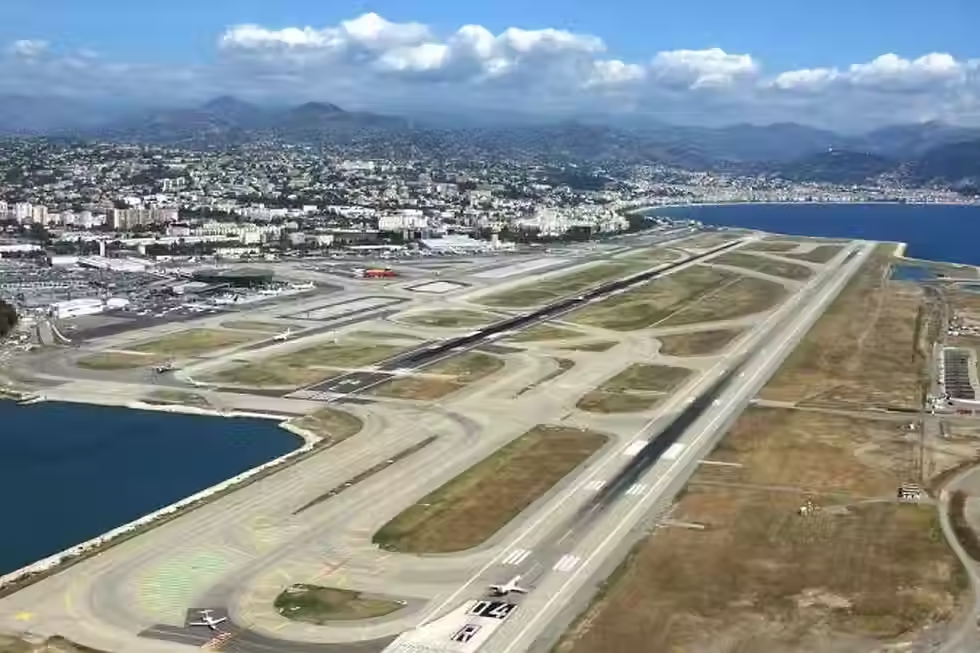
Across Europe, companies such as AirWise Executive Flight Support at Nice Côte d’Azur Airport (LFMN) mirror this same philosophy ,ensuring that ground operations, slot coordination, and flight supervision reflect the highest standards of sustainability and compliance.
From the Middle East’s strategic expansion to Europe’s operational precision, these efforts converge toward one shared goal ,a cleaner, smarter, and more connected future for global business aviation.
For tailored support in Nice, including passenger assistance, and ground supervision, please contact our 24/7 operations desk: ✉️ fbo.nce@airwiseexecutive.com


Comments