From Kerosene to Green Fuel: How AirWise Is Driving the Sustainability Transition in Business Aviation
Updated: Oct 28, 2025
Private aviation has long represented discretion, performance, and prestige. Yet in a world increasingly focused on environmental responsibility, it has also become a focal point of public debate. While private jets account for a small fraction of global air traffic, they remain highly visible, often misunderstood symbols of luxury. What many do not realize, however, is that the business aviation sector is leading the transformation toward cleaner, more efficient, and sustainable flight.
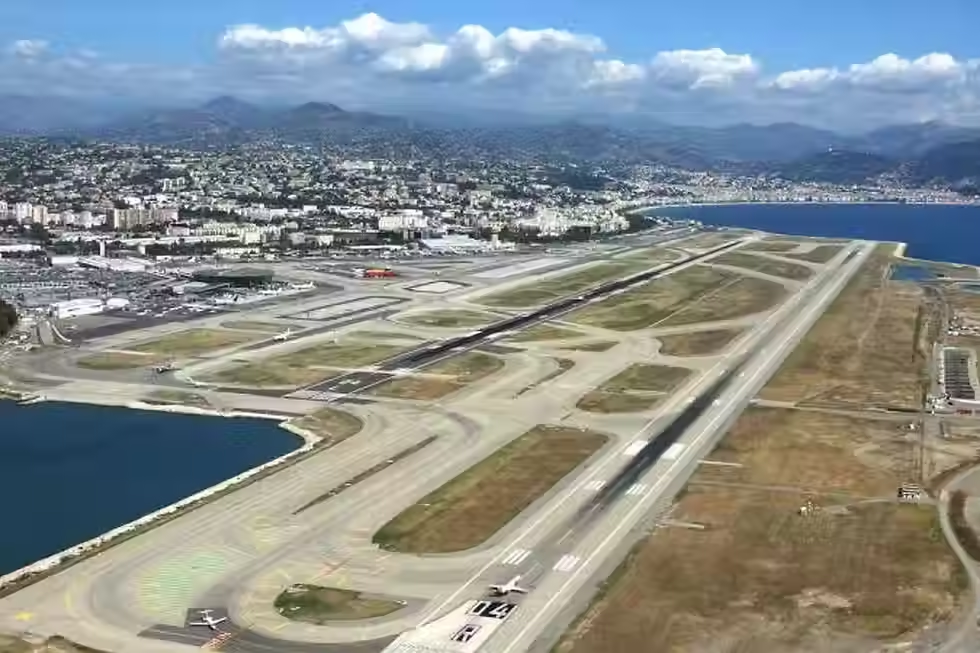
At AirWise Executive Flight Support, sustainability is embedded in every aspect of our mission. Operating with full airside authorization at Nice Côte d’Azur Airport (LFMN), our locally based team ensures that each operation meets the highest standards of efficiency, environmental responsibility, and regulatory compliance. From ground coordination to fuel management, AirWise actively supports aircraft operators, flight departments, and corporate aviation clients in adopting cleaner, lower-carbon practices — including the use of Sustainable Aviation Fuel (SAF) whenever available. Our commitment to transparent sourcing, precise coordination, and continuous monitoring reflects a long-term vision for more sustainable business aviation on the French Riviera.

A Small Industry Under a Big Spotlight
Although business aviation accounts for less than 2 percent of global aviation emissions, its visibility far exceeds its scale. A single private jet movement often attracts more public attention than a commercial aircraft carrying hundreds of passengers. This scrutiny has compelled the sector to accelerate innovation and adopt sustainable practices faster than almost any other segment of air transport.
This agility is also its strength. Business aviation’s flexibility—smaller fleets, shorter decision chains, and direct client relationships—makes it an ideal proving ground for technologies that can later be deployed across the wider aviation ecosystem. Private aviation is not the environmental problem; it is where many of the solutions are first tested and refined.
Sustainable Aviation Fuel: A Practical Revolution Already Taking Off
Sustainable Aviation Fuel (SAF) represents one of the most impactful innovations in the modern history of flight. It is produced from renewable feedstocks such as waste cooking oils, algae, agricultural residues, and captured carbon dioxide. Unlike experimental fuels still in development, SAF can be used immediately in existing aircraft without modification to engines or fuel systems. It is certified under ASTM D7566 standards and can be blended safely with conventional Jet-A1.
When assessed over its entire life cycle, SAF can reduce greenhouse gas emissions by up to 80 percent compared with fossil-based jet fuel. The transition requires no major infrastructural changes at airports, meaning operators can adopt it seamlessly. The long-term objective set by the business aviation community is to achieve 100 percent sustainable fuel use by 2040, supported by partnerships among manufacturers, airports, and fuel providers.
Manufacturers are already leading by example. Dassault Aviation has successfully performed flights using 100 percent SAF in Falcon jets. Bombardier, Gulfstream, and Embraer now deliver aircraft certified for high-blend SAF operations. Major European FBOs, including Paris Le Bourget (LFPB) and Nice (LFMN), are progressively integrating SAF into their refueling systems. AirWise supervises these operations locally, ensuring that uplift requests are properly documented, traceable, and in full compliance with European sanitary and environmental regulations.

How AirWise Integrates SAF Into Its Flight Support Operations
At AirWise, we believe sustainability begins with precise supervision. Our local coordination teams at LFMN, LFTH, and LFML manage SAF ordering and uplift on behalf of operators. We verify blend ratios, storage conditions, and certification documentation to ensure that every litre of fuel meets International Sustainability and Carbon Certification (ISCC) standards. When SAF is not physically available at the point of departure, we guide our clients through verified credit systems that allow them to contribute to SAF production and claim certified emission reductions.
Our goal is not only to facilitate sustainable fuel use but also to educate and guide operators through the evolving regulatory and technical frameworks of European aviation. We maintain close communication with DSNA/CDM France and local airport energy providers to anticipate SAF availability, pricing changes, and logistical considerations. Clients may request AirWise’s SAF compliance documentation and certification records by email for auditing or ESG reporting purposes.
Beyond SAF: Hydrogen, Electric, and the Next Generation of Propulsion
Sustainability in aviation extends beyond fuel composition—it involves rethinking the entire propulsion paradigm. Across Europe and North America, developers are experimenting with hydrogen, electric, and hybrid systems that could fundamentally reshape air transport within the next two decades.
Hydrogen propulsion is being tested by companies such as ZeroAvia and Airbus, offering the potential for zero in-flight carbon emissions and minimal noise. Electric aircraft projects like Eviation Alice and VoltAero Cassio are pioneering fully electric regional and business aircraft ideal for sub-1,000-kilometre missions. Even the next generation of supersonic aircraft, including Boom Supersonic’s Overture, is being designed to operate exclusively on sustainable aviation fuel.
AirWise closely monitors these advances, ensuring that our infrastructure and services evolve in parallel. Our mission is to remain operationally ready to support new energy technologies as they move from prototype to reality. We see sustainability not as an obligation but as an opportunity to redefine operational excellence in business aviation.
Eco-Responsible Inflight Catering: Sustainability Beyond the Tank
The environmental transition in aviation goes well beyond fuel efficiency—it also transforms the culinary standards that define premium private travel. Through its dedicated Culinary Division, AirWise Executive Flight Support has established enduring collaborations with certified VIP inflight catering partners across France, particularly along the French Riviera, including Nice Côte d’Azur Airport (LFMN). Each partner operates under strict European sanitary certification, guaranteeing that every meal arranged and supervised by AirWise adheres to the highest levels of hygiene, quality, and sustainability, fully aligned with the expectations of today’s environmentally conscious travelers.
AirWise works closely with these select catering providers to promote responsible sourcing and transparent supply chains, emphasizing seasonal and locally grown ingredients from certified French and Italian producers. Together, we encourage sustainable practices such as the reduction of food waste and the use of aviation-friendly recyclable packaging, including biodegradable foils, compostable microwave-safe containers, and lightweight materials designed to minimize cabin waste and optimize onboard storage.
This collaborative approach ensures that passengers enjoy an authentic fine-dining experience that is both luxurious and environmentally conscious. Each menu reflects regional culinary artistry while adhering to the operational standards required for business aviation.
Beyond the onboard service, AirWise also coordinates post-flight waste management, verifying that unused food and materials are handled through certified collection and recycling channels in line with French and European Union environmental directives. This integrated method demonstrates AirWise’s broader philosophy: sustainability is not confined to the flight deck—it is woven into every element of the journey, from ground coordination to inflight dining.
Challenges and Opportunities Ahead
Despite strong progress, Sustainable Aviation Fuel still faces economic and logistical challenges. Production capacity remains limited, and SAF prices are typically two to three times higher than conventional jet fuel. Nevertheless, as global demand grows and production scales up, costs are expected to fall steadily. Governments across Europe, including France, are introducing incentives and mandates to accelerate the transition, while airport operators are investing heavily in dedicated SAF storage and distribution facilities.
AirWise works closely with these entities to ensure that private jet operators remain informed and prepared. We act as an intermediary between the operator, the fuel supplier, and airport authorities, ensuring transparent invoicing, accurate CO₂ reduction calculations, and full compliance with EU environmental reporting requirements. Our expertise allows our clients to integrate sustainability goals into their operational strategies without compromising schedule, service quality, or passenger experience.
Business Aviation as a Catalyst for Change
Business aviation is often misunderstood, yet its role in innovation is undeniable. Many of the environmental technologies that will later benefit commercial aviation are first validated within the private sector. From flight-planning software that reduces fuel burn to hybrid ground vehicles and optimized slot management systems, private aviation acts as a living laboratory for sustainable progress.
By combining operational precision, regulatory expertise, and client-specific sustainability programs, AirWise demonstrates that environmental responsibility and premium service are not opposites—they are inseparable elements of modern executive aviation. The clients who choose AirWise do so not only for efficiency and discretion but also because they understand that every responsible flight today shapes the aviation of tomorrow.
As we often affirm:It is not the fuel that defines the flight; it is the vision of those who choose to operate responsibly.
The AirWise Sustainability Roadmap
Innovation | Environmental Impact | Implementation Timeline |
Sustainable Aviation Fuel (LFMN / LFTH / LFML) | Up to 80% CO₂ reduction over full lifecycle | Available now |
Hydrogen and Electric Propulsion Readiness | Zero in-flight emissions potential | 2030–2040 |
Eco-Friendly Ground Power and Vehicles | Lower ground-handling emissions | Ongoing |
Smart Slot and Taxi Optimization | Reduced APU and taxi-time fuel use | Active |
Carbon Offsetting and Verified Credits | Measurable progress toward net-zero goals | Immediate |
About AirWise’s Commitment to Sustainability
AirWise Executive Flight Support is a licensed and locally accredited supervisory provider based at Nice Côte d’Azur Airport (LFMN), with operational capability extending across Marseille Provence (LFML) and other South of France airports. From flight planning and fuel coordination to inflight catering and on-site supervision, sustainability is embedded in every aspect of our activity. Our goal is to help operators minimize their environmental impact while maintaining the highest levels of service, safety, and regulatory compliance. Through collaboration with certified partners, responsible sourcing, efficient ground procedures, and a commitment to transparent ESG practices, AirWise continues to shape a smarter, more sustainable future for business aviation in France.
Final Thoughts
Transitioning from traditional kerosene to sustainable aviation fuel is more than an environmental commitment — it is a strategic shift that defines the future of business aviation. The success of this transition depends not only on innovation but also on precise local coordination, verified sourcing, and expert supervision.
At AirWise Executive Flight Support, sustainability is not a concept—it is a daily operational practice. From arranging Sustainable Aviation Fuel (SAF) refueling at Nice Côte d’Azur Airport (LFMN) to coordinating flight schedules through CDM/DSNA and managing eco-efficient ground operations across the French Riviera and other key French airports, our team ensures that every stage of the operation is executed with precision, full compliance, and complete transparency.
In a changing world, responsible aviation is not achieved by promises but by precision.At AirWise, we believe that sustainability is the new form of operational excellence.
For SAF coordination, certified fuel documentation, or green flight supervision at Nice, Cannes, or Marseille, contact our operations team:✉️ fbo.nce@airwiseexecutive.com


Comments