How Business-Aviation Airports in Europe Remain Resilient in 2025

In 2025 the European business-aviation ecosystem continues to demonstrate resilience. For operators servicing the Côte d’Azur and beyond, understanding the structural shifts, market trends, taxation, technological innovation, environmental transition,will be vital. Drawing on official sources including the European Business Aviation Association (EBAA), Eurocontrol, European Union Aviation Safety Agency (EASA), International Civil Aviation Organization (ICAO) and Oxford Economics, this article offers a clear and detailed perspective for fleet-managers, operators and industry partners. The mission: equip you with actionable insight for handling high-end operations around Nice Côte d’Azur Airport (LFMN), the Riviera and the wider European business-aviation network.
Macroeconomic backdrop & market profile
The business-aviation segment in Europe in 2025 remains firmly rooted in a post-pandemic landscape. While the early rebound momentum has levelled off, operators now face a convergence of headwinds: kerosene price inflation, geopolitical volatility, evolving regulation and slower growth in the ultra-luxury travel segment. According to Oxford Economics’s study commissioned by EBAA and the General Aviation Manufacturers Association (GAMA), business aviation contributes around €100 billion annually to European GDP and supports more than 370,000 jobs. In this context, for high-net-worth-individual (HNWI) and ultra-HNW market segments (which include Riviera-based private-jet traffic, arts/fashion/leisure…), the premium-mobility model continues to differentiate. Operators active at Nice, Cannes, Monaco etc. must therefore adapt to a mature market environment where growth is modest but expectations of service, flexibility and compliance are very high.
Traffic trends in 2025 and strategic hubs
Traffic across European business aviation in 2025 is expected to mark only marginal growth. Industry-intelligence from Argus International forecasts an annual rise of just +0.3% in movements. Major hubs remain dominant. Airports such as Paris‑Le Bourget Airport (LFPB), Geneva Airport (LSGG), Nice Côte d’Azur (LFMN), London (EGLF) and Munich (EDDM) continue to handle the lion’s share of business-jet operations. Meanwhile, secondary hubs in Southern or Central Europe (for example Vienna (LOWW), Malaga (LEMG), Ibiza (LEIB), Prague (LKPR) are benefiting from modern infrastructure, relaxed slot pressure and growing leisure-business traffic.For the Côte d’Azur operator, the key takeaway is that slot availability, ramp access and parking capacities will remain tight at prime seasons. Flexibility and advanced coordination,especially for marquee events (Monaco Grand Prix, Cannes Film Festival, Yacht Show),will be essential.
The economic role and value-added of business aviation
Business aviation is not simply a luxury transport option; it is a strategic connectivity enabler. The Oxford Economics report quantifies the risks: overly restrictive policies could cut up to €120 billion in foreign direct investment (FDI) by 2030, and 104,000 jobs across Europe.
Approximately 80 % of European business-aviation served airport-pairs do not have scheduled-airline alternatives, illustrating the sector’s unique role in linking dispersed markets. For AirWise clients operating out of Nice and the Riviera, this means that their operations directly support regional-connectivity, premium-mobility sources, and luxury/leisure circuits. Ensuring compliance, reliability and local-expertise therefore becomes a competitive differentiator.
Operational resilience at airport-level: Côte d’Azur focus
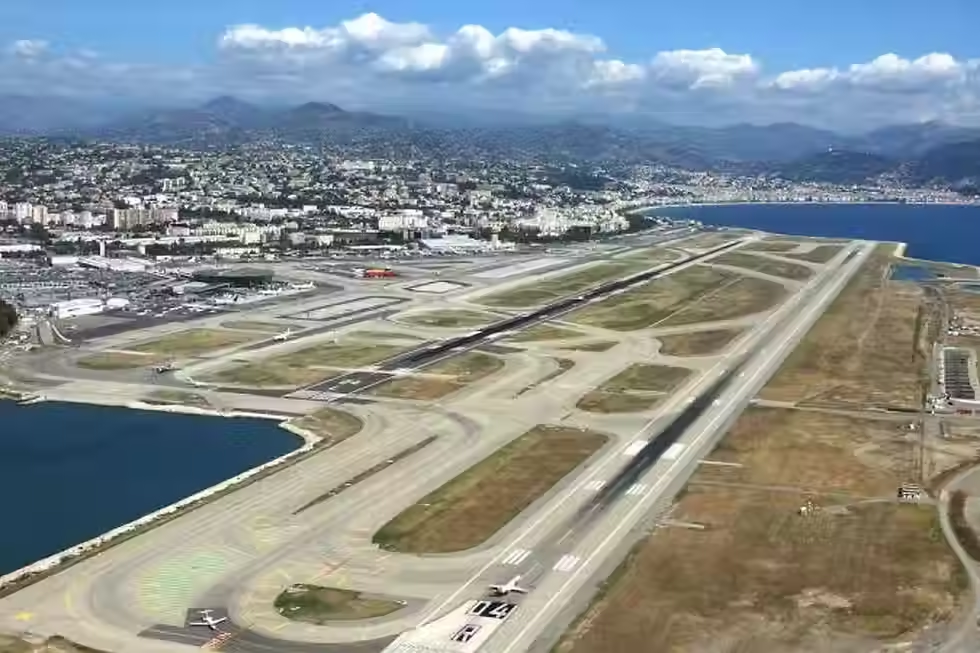
LFMN (Nice Côte d’Azur) and neighbouring destinations (Cannes, Monaco, Saint-Tropez) face particular operational dynamics in 2025:
Slot and parking pressure
Even in a stable-growth market, congestion remains a feature. Key events drive peaks: e.g., summer tourism, luxury-yacht arrivals, international conferences. Ramp-access, handling-coordination, parking management and airside supervision must be tighter than ever. As AirWise’s supervisory framework emphasises, early slot/overflight-permit coordination, grounded in local-licensed authority access, distinguishes reliability.
Service-differentiation and concierge value-add
Premium passengers expect more than just a seat. VIP inflight-catering, fine-dining ground pickups, helicopter transfers, local supervision are now baseline expectations. For example, AirWise’s Concierge Branch supplying VVIP inflight-catering or luxury-ground pickups demonstrates how value is built beyond pure movement numbers.
Regulatory & tax environment
France in 2025 is enforcing the “solidarity tax” on air-passenger transport. The document prepared by EBAA France clarifies that commercial flights departing French territory (including Corsica) are subject to this tax. Helicopter non-scheduled flights are included, and operators must apply correct tax-rates. Jet operators using the Côte d’Azur must account for such taxes in their cost-models, and ensure correct classification of flight type (commercial/non-commercial) to avoid surprises.
Environmental transition & technology adoption
Though growth is modest, the sector is increasingly defined by its environmental agenda. At the recent EBACE 25 event, speakers stressed that Europe’s business-aviation fleet (over 4,000 aircraft) is shifting toward younger airframes, and usage patterns are evolving in response to sustainability and regulatory pressures. Operators must prepare for Sustainable Aviation Fuel (SAF) mandates (e.g., via ReFuelEU Aviation), decarbonisation frameworks and noise/operational constraints that may impact airport access, particularly in premium regions such as the Côte d’Azur. The sector is positioning itself as a test-bed for innovation.
In 2025, Europe’s business-aviation hubs remain resilient but operate in a mature and tightly-balanced market. For operators servicing the Côte d’Azur, success hinges less on chasing volume growth and more on operational excellence, local expertise, service differentiation and compliance.
AirWise’s unique value proposition — fully licensed for on-site flight support and personalized meet-and-greet assistance at Nice Côte d’Azur Airport (LFMN), ensuring precise coordination with local authorities, handlers, and customs teams for every arrival and departure across the Riviera — positions it as an indispensable partner for premium jet operators.
By aligning with these strategic imperatives and anticipating the evolving regulatory, tax and environmental landscape, operators will safeguard reliability, protect margins and strengthen their competitive standing in one of the world’s most demanding business-aviation markets.
For tailored support in Nice, including passenger assistance, and ground supervision, please contact our 24/7 operations desk: ✉️ fbo.nce@airwiseexecutive.com


Comments